

Why Explore Trust?
Understanding the importance of trust in human systems
Trust is the foundation of society.
It underpins nearly all social interactions, whether explicitly acknowledged or subtly operating in the background. At its core, trust is an emergent property of relationships—it requires at least two entities, one extending trust and another receiving it. Over time, trust can become mutual, reinforcing cooperation and stability. Its absence, however, can create cycles of distrust with far-reaching consequences.
Trust matters at every level.
From personal relationships to institutions and broader societal systems, trust facilitates smoother interactions, enables collaboration, and forms the foundation for effective cooperation. Yet it is rarely static: trust fluctuates based on context, past experiences, and systemic conditions. It can strengthen or erode over time, depending on whether expectations are met or betrayed.

The challenge today
Social, economic, and environmental challenges are converging at an unprecedented scale. Many institutions and communities are grappling with fragmentation, exhaustion, and declining confidence in existing systems. Leaders working toward social change face urgent questions:
How can trust be cultivated and sustained in the face of uncertainty and disruption?
What strategies support trustworthy, decentralized leadership in diverse networks?
How can we ensure trust remains strong enough to support adaptive, rapidly evolving responses to change?

Looking to nature for guidance
Addressing today’s complex, interconnected challenges requires more than traditional, mechanistic approaches. It demands iterative, collaborative, and regenerative thinking. Many are turning to nature for guidance, drawing on biomimicry—the practice of learning from and emulating nature’s strategies—to inspire solutions for human systems. By examining trust in the natural world through 3.8 billion years of evolutionary intelligence, we can discover principles that inform human relationships and social structures. These insights can help us build trust that is resilient, adaptive, and long-lasting.
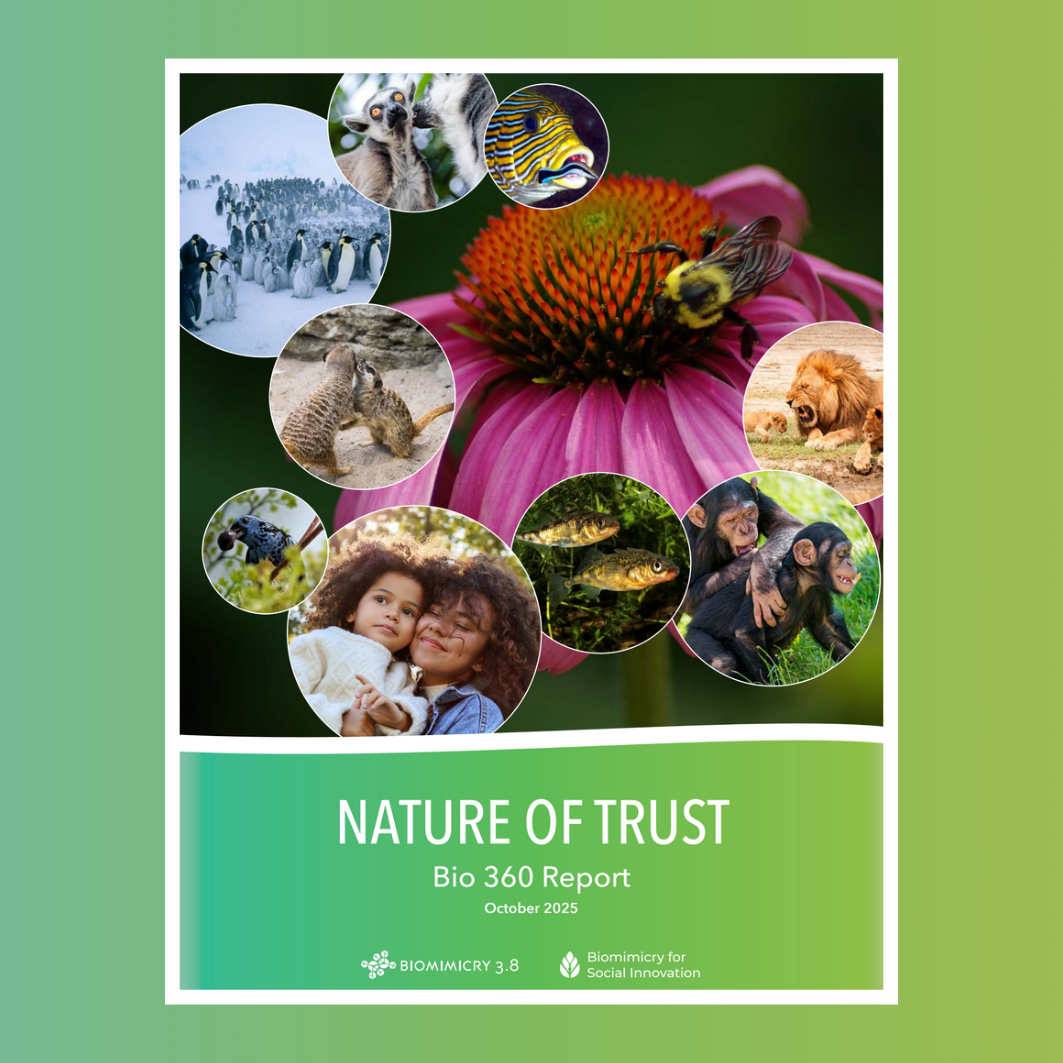
Bio360: Nature of Trust
The Bio360: Nature of Trust Report explores how trust manifests in living systems and what lessons can be drawn for human interactions. The resulting framework and toolkit provide practical guidance for leaders, changemakers, and communities seeking to strengthen trust across relationships, organizations, and systems.
Understanding the building blocks of trust
Roxey Nelson of 1199 SEIU, the nation’s largest healthcare union, reflects on the value of turning to the natural world for insights on trust.